
AI receptionist cost UK: what you'll actually pay
31 July 2026 · 9 min read

Most "AI receptionist" pricing pages tell you the headline number and hide the rest. This post does the opposite: the actual RedAgents plans, what happens when you go over your minutes, how that compares with a traditional answering service or a part-time hire, and the arithmetic on how many jobs it needs to catch to pay for itself. There's also a section on when a human answering service is the better buy.
The plans, in full
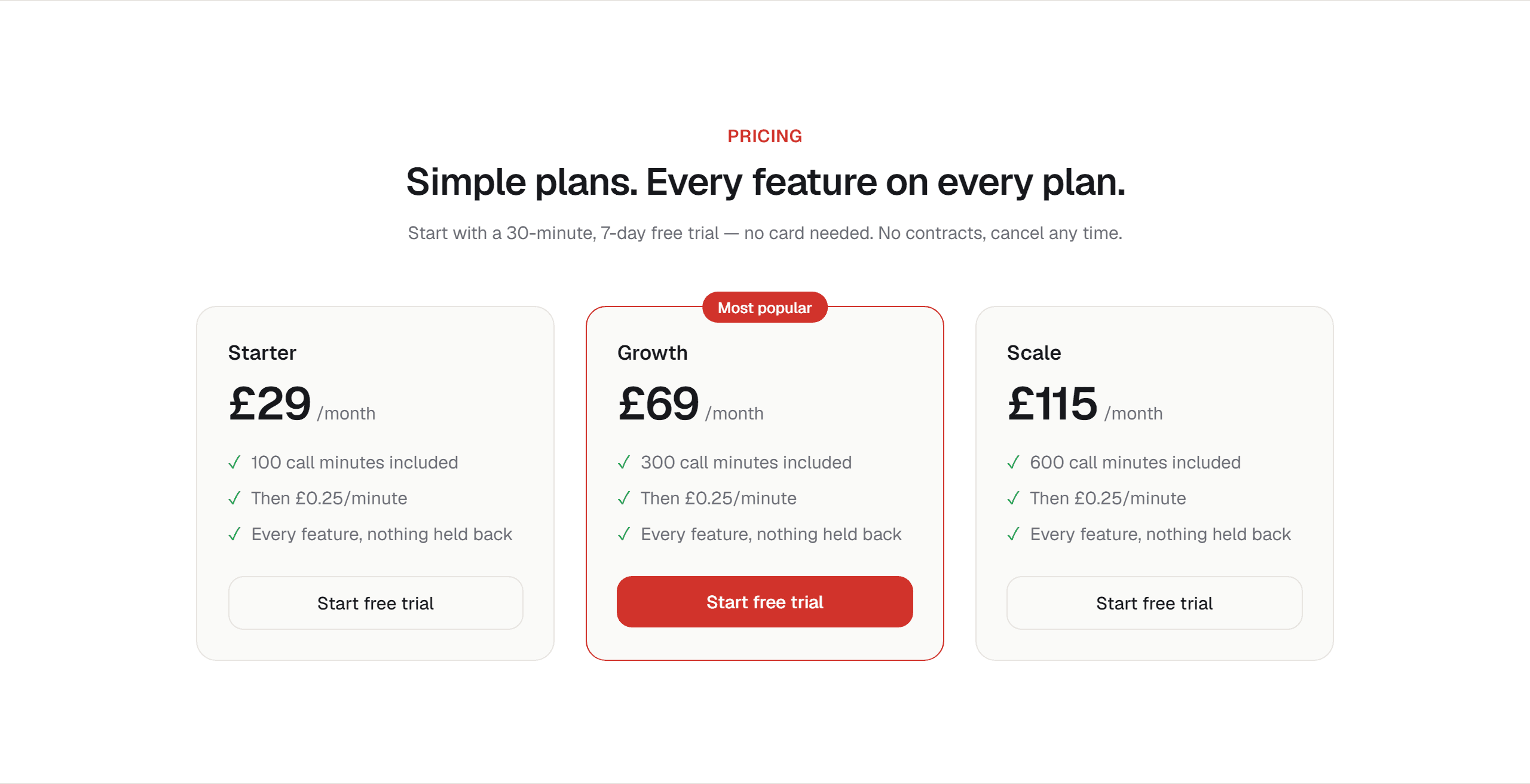
RedAgents receptionist pricing has three tiers. The only difference between them is how many call minutes are included. Every feature is on every plan — nothing is held back for the expensive tier.
| Plan | Monthly price | Included minutes | Over the allowance |
|---|---|---|---|
| Starter | £29 | 100 call minutes | £0.25 per minute |
| Growth | £69 | 300 call minutes | £0.25 per minute |
| Scale | £115 | 600 call minutes | £0.25 per minute |
There's a 30-minute, 7-day free trial with no card needed. No contracts, cancel any time. You can see the tiers on the receptionist page if you'd rather look at them yourself.
What "a minute" actually means for your bill
Minutes are the unit that matters, so it's worth thinking in calls rather than months. A missed-call callback — who's ringing, what they want, when they want it, an address, a rough price — is usually a short conversation. Call it two to three minutes. A more involved one, where someone talks you through a bathroom job or a first-time patient runs through their history, might be five.
So on a three-minute average:
- Starter (100 mins) — roughly 33 calls a month, or about 8 a week.
- Growth (300 mins) — roughly 100 calls a month, or about 23 a week.
- Scale (600 mins) — roughly 200 calls a month.
Remember what's being counted. If you forward only the calls you miss — using the dial code, so your own phone rings first — the receptionist is handling the overflow, not your whole switchboard. For a lot of one-van trades, that's a handful of calls a week, and Starter is plenty. A busy salon with a chair-side phone nobody can reach on a Saturday will burn through more.
The overage rate is worth understanding too, because it means you can't get stung by a surprise tier upgrade. If you're on Starter at £29 and you have a mad month — 160 minutes instead of 100 — the extra 60 minutes costs £15. Total £44. Consistently over? Move up a plan, because Growth's 300 minutes at £69 works out cheaper than 100 minutes plus 200 minutes of overage (£29 + £50 = £79).
Quick rule of thumb for picking a plan
Take the number of calls you reckon you miss in a normal week. Multiply by 3 (minutes), then by 4.3 (weeks). That's your monthly minutes.
Miss 5 calls a week? 5 × 3 × 4.3 = about 65 minutes. Starter. Miss 20 a week? About 260 minutes. Growth.
If you genuinely don't know — and most owners don't, because a missed call leaves no trace — start on Starter and watch the call log for a month. The dashboard counts them for you.
How this compares with a traditional answering service
UK human answering services typically price one of three ways: a monthly fee with a bundle of calls included, a per-call charge (often with a minimum monthly commitment), or per-minute billing. Many combine a small monthly fee with a per-call rate on top. Rates vary enormously depending on whether you want a shared receptionist reading a script or a dedicated team who know your diary.
Rather than invent numbers for a market that ranges from cheap script-readers to premium legal-sector services, here's the structural difference — which is what actually drives your bill:
| AI receptionist (RedAgents) | Typical human answering service | |
|---|---|---|
| Billing unit | Monthly plan + £0.25/min over | Per call, per minute, or bundled calls |
| Cost of a quiet month | Just the plan fee | Often a minimum commitment regardless |
| Cost of a busy month | Predictable — £0.25 a minute | Rises with call volume, sometimes steeply |
| Out-of-hours cover | Included, same price | Often a premium add-on or separate rate |
| Contract | No contract, cancel any time | Frequently 30-day notice or annual terms |
| What they know about you | Built from your website | Whatever you brief them with |
The honest read: for low volumes, both can be affordable. Where the AI pricing tends to look better is out-of-hours and weekends, because there's no night rate — the same plan covers 3am on a Sunday. Where a human service can win is on a small number of high-value, complicated calls, which we'll come to.
If you want the wider comparison — voicemail, human service, in-house hire, AI — we wrote that up separately in AI receptionist vs answering service vs voicemail.
Compared with hiring someone part-time
This is the comparison most owners have already run in their head and dismissed, but it's worth being precise about why.
Take a part-time receptionist, 20 hours a week. At the time of writing the UK National Living Wage for workers aged 21 and over is £12.21 an hour. So:
- 20 hours × £12.21 = £244.20 a week
- × 52 weeks = £12,698 a year, before anything else
- Then employer's National Insurance, pension contributions, holiday cover, and the desk, phone and computer they sit at
- Call it comfortably north of £14,000 a year in real terms
That's roughly £1,170 a month for 20 hours a week of cover — which is about 12% of the week. Nights, weekends and their lunch break are still voicemail. RedAgents Scale, at £115 a month, is under a tenth of that and covers 168 hours a week.
That is not a like-for-like comparison and pretending it is would be dishonest. A good human receptionist chases invoices, manages the diary properly, calms down an angry customer, makes tea, and handles the fifteen things a week that don't fit any script. What the numbers do tell you is that "hire someone to answer the phone" was never a realistic option for a business turning over £150k with two vans — and that's exactly the gap the AI fills.
Does it pay for itself? Do the maths on your own numbers
Forget generic ROI claims. Use your own average job value. The question is simply: how many extra jobs a month does this need to win?
One extra job a month
Plumber. Average job £180. Starter at £29/month is paid for by one extra booked callout — with £151 left over. A boiler swap at £2,000 pays for Scale for well over a year.
Salon. Average booking £45. Starter needs one extra cut a month to break even. If that client comes back every six weeks, the plan is paid for indefinitely on one saved booking.
Private clinic. Initial consultation £120. One extra new patient covers Growth (£69) with change, and the lifetime value of a patient who books a course of treatment is a multiple of that.
Electrician. Average job £250. Scale at £115 needs one extra job every two months to wash its face.
The uncomfortable version of this sum: if you're missing five calls a week and even one in ten of them would have booked, that's roughly two jobs a month walking to the next name on Google.
We went through the missed-call arithmetic in more detail — including how to work out your own capture rate — in what missed calls really cost a UK trades business.
Costs people forget to budget for
Three things that often surprise people when they price up phone cover, and where RedAgents sits on each:
- Setup or onboarding fees. Some services charge for scripting and training. RedAgents builds the script from your website in about a minute — no setup call, no fee.
- A new phone number. Changing the number on your van, cards and Google listing costs real money and loses you calls from old adverts for years. You keep your existing number; one dial code forwards only the calls you miss.
- Call recording and transcripts. Sometimes a paid extra elsewhere. Every call is recorded and transcribed in the dashboard on all three plans.
And one thing that isn't a cost but is a saving: quotes, bookings and follow-ups are drafted and held in your approvals inbox until you tap approve. You're not paying someone to guess your prices, and you're not paying for the fallout when they guess wrong.
When a human answering service is the better fit
There are businesses where the cheaper option is the wrong one. Be honest with yourself about whether you're one of them.
- Your calls are long, emotional or clinical. Bereavement services, mental health practices, safeguarding lines, anything where the first thirty seconds needs a person who can read a wobble in someone's voice. Pay for a human. It's not a cost question.
- Volume is low but each call is worth thousands. If you take six calls a month and each one is a £40,000 job, a dedicated human team who genuinely know your business is worth several hundred pounds a month. The £29 plan is not where you should be optimising.
- You need the caller to reach a person, now. An AI receptionist takes the details and holds the action for your approval. If your customers need same-minute dispatch of an engineer or an on-call clinician, you need a human with a call tree and an escalation list.
- Your enquiries can't be answered from your website. The receptionist is built from what's on your site. If your pricing is bespoke, your service list lives in your head, and every call is a negotiation, expect it to take good messages rather than quote accurately.
- Regulated advice. If saying the wrong thing on the phone has legal consequences — financial advice, some healthcare, immigration — the AI can still catch out-of-hours calls and take details, but don't ask it to advise.
- A lot of non-English calls or heavy accents in a noisy setting. A human on a good headset will handle a hard line better than any speech system.
The middle ground plenty of businesses land on: AI for the overflow and the out-of-hours, humans for the daytime calls you answer yourself. That's the arrangement the dial code is designed for — your phone rings first, and only what you actually miss goes to the AI.
How to test the cost before committing
- Start the 7-day, 30-minute free trial. No card. You'll hear it answer in about a minute using your own website.
- Ring it yourself, twice — once as an easy enquiry, once as your most awkward customer. Time both calls. That's your real average minute count.
- Set the dial code so only missed calls forward, then leave it a fortnight and look at the call log. Now you know your monthly minutes rather than guessing.
- Pick the plan that covers that number with a bit of headroom, knowing overage is £0.25 a minute rather than a forced upgrade.
- Compare the monthly figure against one average job, not against zero. Zero isn't the alternative — voicemail is, and voicemail has a cost too.
Never miss another job
RedAgents answers every call 24/7 in your business's name — books jobs, sends quotes, and texts you after every call. Live in about 60 seconds.
See the AI receptionist →