
Answering service prices: what the UK models really cost
21 August 2026 · 8 min read

Photo by Mathieu Stern on Unsplash
Ring round three telephone answering services and you'll get three quotes that can't be compared. One charges per call, one per minute, one sells you a bundle of minutes. The headline number tells you almost nothing about what you'll actually pay in March when the boiler jobs land. This post explains the four pricing models, shows which one punishes a good month, and does the arithmetic on what a single recovered job covers.
Four models, and only four
Whatever the sales page says, UK answering service prices come in four shapes. Everything else is a variation on these.
| Model | How you're billed | Who it suits |
|---|---|---|
| Per call | A fixed fee each time your line is answered, regardless of length | Very low, very predictable call volumes |
| Per minute | A rate per minute of talk time, often rounded up | Businesses with lots of short calls |
| Bundled minutes | A monthly fee that includes a set number of minutes, then a rate after | Most small businesses with a rough idea of volume |
| Flat monthly | One price, minutes included, no per-call charge | Anyone whose volume swings month to month |
Commonly, per-call and per-minute plans come with extras stacked on top: a setup fee, a higher rate for out-of-hours and weekends, a charge for message delivery, sometimes a minimum monthly spend that quietly makes the "pay as you go" model a subscription anyway. Ask for those before you sign anything. They're rarely on the front page.
Why per-call pricing punishes a good month
This is the part nobody explains, and it's the reason so many owners cancel in month four.
Under a per-call model, your bill is a direct function of how busy you are. That sounds fair. It isn't, because busy and profitable don't arrive in a straight line, and neither does your ability to pay.
Think about a heating engineer. January is the busiest month of the year. The phone doesn't stop. It's also the month you're working fourteen-hour days, running low on parts, and turning work away because you physically cannot get to it. Under per-call billing, that's your most expensive month for answering — including all the calls you couldn't service, all the calls from people ringing round for a second quote, all the wrong numbers, and all the callers who were only chasing an invoice.
You pay the most in the month you have the least capacity to convert. And the calls you're paying extra for include a good chunk you'd never have wanted in the first place.
Do the maths: the volume swing
Say you're a plumber. A quiet August: 40 calls. A cold January: 150 calls. Under per-call pricing your January bill is roughly 3.75× your August bill — even though your January hourly rate hasn't gone up and you turned away a third of the work.
Under a flat monthly plan, both months cost the same. You can budget it like insurance or a van lease: one line on the spreadsheet, twelve times a year.
Neither model is dishonest. But one of them makes your cost of answering unpredictable in exactly the months you're least able to think about it.
The per-minute trap: rounding and length
Per-minute pricing looks like the fairest of the lot. A thirty-second call costs half a minute, right?
Commonly, no. Per-minute billing is usually rounded up to the nearest minute, and sometimes there's a minimum billable duration per call. So a fifteen-second call from a courier asking which door to use gets billed as a full minute. Ten of those a week and you're paying for time nobody spent.
There's a second problem, subtler. Per-minute billing gives the answering service no reason at all to be brisk. Nobody is deliberately padding calls. But if a longer call earns more, the incentive points the wrong way, and you'll never be able to prove either way. With bundled or flat pricing, the incentive is neutral.
What a flat plan actually looks like
RedAgents publishes its plans, so here they are as the worked example rather than a hypothetical.
| Plan | Monthly | Minutes included | After that |
|---|---|---|---|
| Starter | £29 | 100 | £0.25/minute |
| Growth | £69 | 300 | £0.25/minute |
| Scale | £115 | 600 | £0.25/minute |
Every feature is on every plan — the plans differ only by minutes. There's no setup fee, no contract, and out-of-hours and weekends cost the same as a Tuesday morning. There's a 7-day free trial with 30 call minutes and no card needed.
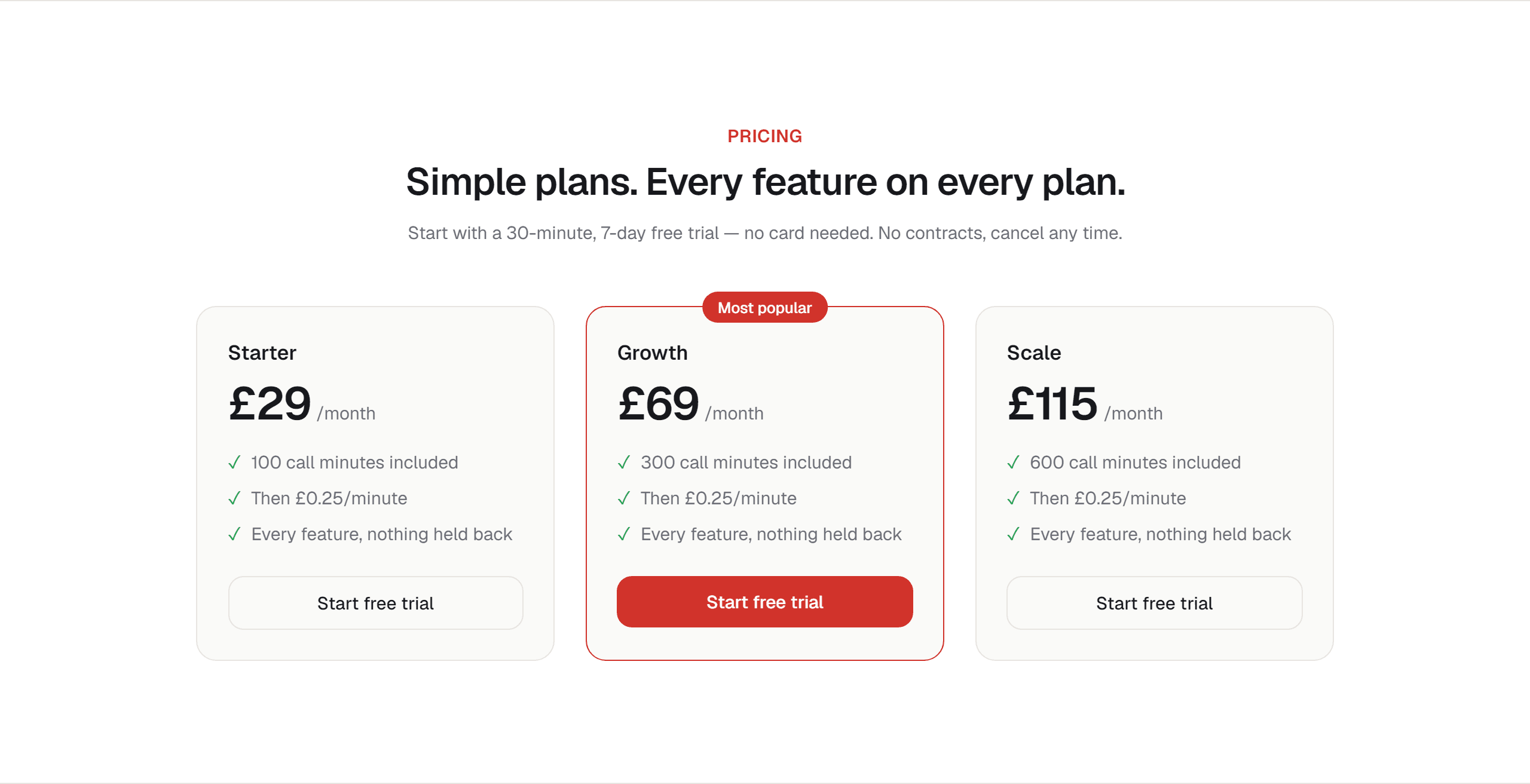
Note what the minutes buy. Starter's 100 minutes is roughly thirty to forty short calls a month, depending on how much detail your callers give. Growth's 300 minutes is a proper flow of enquiries. If you overshoot, the overage is £0.25 a minute — so a busy month doesn't cut you off, it just costs a bit more. Twenty minutes over on Starter is £5. That's the point: the cost of a good month is a rounding error, not a shock.
If you want the full cost breakdown including comparisons with a part-time hire, we've written that up separately in AI receptionist cost UK.
What one recovered job a month covers
Here's the arithmetic that matters more than the price list. You aren't comparing answering service prices against zero. You're comparing them against the jobs that currently go to the next name on Google.
Do the maths: one job
Say a boiler swap is worth £2,000 to you, with £600 of that as margin after parts and your time. The Growth plan at £69/mo costs you £828 a year.
One recovered boiler swap covers the whole year, with £600 of the £828 paid off in a single afternoon's margin — you'd need roughly one and a half of them across twelve months to break even.
Lower-ticket work needs more volume. A salon colour at £85 with, say, £50 of margin: you need about two recovered bookings a month to cover Starter at £29, and around 17 a year to cover Growth. A physio at £45 a session where the client comes six times is a £270 relationship — one recovered new patient a quarter covers Growth comfortably.
Run this with your own numbers, not ours. The question is simply: how many jobs a month does the fee represent, and do I currently miss that many calls? If you genuinely miss two calls a week, you already know the answer.
We've gone deeper into that calculation, including how many of your missed calls actually turn into work, in what missed calls really cost a UK trades business.
Where per-call pricing is genuinely cheaper
It would be easy to write off per-call billing. It isn't always the wrong choice, and here's the honest case for it.
If your call volume is very low and reliably low, per-call wins. A specialist consultant who takes six enquiries a month. A high-end joiner working from referrals with a six-month order book. A B2B supplier where everything happens by email and the phone rings when a delivery goes wrong. In those businesses, paying a small fee six times is cheaper than paying £29 for a hundred minutes you'll never use.
The threshold is roughly this: work out what a per-call provider would charge you for a typical month, and compare it with £29. If your realistic per-call bill is well under £29 and your volume never spikes, take the per-call deal. You're not the customer a flat plan is designed for.
Two things to check before you commit, though. First, ask whether there's a minimum monthly charge — many per-call plans have one, and it can wipe out the saving entirely. Second, be honest about whether your volume really is flat. Seasonal trades think they're low-volume in July and find out otherwise in November.
Other places a paid answering plan doesn't fit
Beyond the very-low-volume case, there are situations where none of these models is the right spend.
- You already answer nearly everything. Office-based businesses with someone at a desk from nine to five, and no meaningful out-of-hours enquiry flow, are paying to solve a problem they haven't got.
- Your calls need clinical or legal judgement on the spot. An AI receptionist takes details, books and quotes to your standard prices, and passes it to you. It isn't a person and it can't make a triage decision. That's a hard limit, not a setting.
- Your problem is the quote, not the call. If enquiries reach you fine and then sit for four days, answering isn't your bottleneck. Approving quotes from the van is the better read.
- You have no capacity anyway. If you're booked six months out and turning work away, catching more enquiries just means disappointing more people. Fix capacity or pricing first.
Five questions to ask any provider
- Is there a setup fee, and is there a minimum monthly charge?
- Do out-of-hours, weekends and bank holidays cost more than weekdays?
- How is call time rounded — to the second, or up to the next minute?
- Is there a contract term, or can I stop at the end of a month?
- What happens on my busiest month — is there a cap, a queue, or just a bigger bill?
That fifth question is the one that separates the models. On a per-call plan the answer is a bigger bill. On a traditional service with limited staff, it's a queue — your caller waiting on hold while someone in a call centre finishes another business's enquiry. On a flat AI plan there's no queue, because there's no shared pool of humans; calls are answered at once and the price is the price plus £0.25 a minute over your bundle.
If you want the wider comparison — voicemail, a traditional service, an in-house hire, or AI — we've laid all four side by side in AI receptionist vs answering service vs voicemail. And if you'd rather just hear what one sounds like on a real UK number before comparing anything, the answering service page has 30 free minutes with no card.
Never miss the call that pays for the month
RedAgents answers every call in your business's name, 24/7, takes the details and texts them to you. 30 minutes free, no card.
Hear it answer →