
A steady pipeline without ads: contact-form outreach for UK SMEs
12 August 2026 · 8 min read

Photo by Cytonn Photography on Unsplash
You want commercial work — the offices, the letting agents, the salons that need a contractor on the books. But cold email feels grubby and lands in spam, and Google Ads eats £500 before you've learned anything. This post explains a third route: submitting a tailored enquiry through the contact form a business already published. How it works, what it costs, and the four things that stop it working.
The problem with the two usual options
If you want B2B customers and you're not going to knock on doors, most advice pushes you at one of two things.
Cold email. You buy or scrape a list, send a few hundred messages, and hope. In the UK that drags UK GDPR and PECR behind it, your domain reputation takes a beating, and most of it never reaches an inbox. I've covered the detail in contact-form outreach vs cold email.
Paid ads. Ads work, but they're a rented tap. You pay for clicks whether or not they turn into anything, you're bidding against national firms with deeper pockets, and for genuinely commercial work the search volume is often thin. "Office plumber Leeds" isn't a busy search term. The facilities manager isn't googling — she's got a contractor already and is mildly annoyed with them.
Neither of those is the only way to start a conversation with another business.
The third route: their own front door
Nearly every business publishes a contact form. It sits on their website with a heading like "Get in touch" or "Request a quote". That form exists for one reason: they want people to contact them. It's an invitation they put up themselves.
Contact-form outreach means writing an enquiry and submitting it there, the same way a customer would. No list buying, no inbox to bypass, no unsubscribe link needed because you're not sending email.
The catch has always been time. Reading a business's website properly, writing something specific to them, finding the form, filling it in — that's five to ten minutes a go if you're doing it honestly. Twenty a day is most of a working morning, and you're on a roof.
What Find Customers actually does
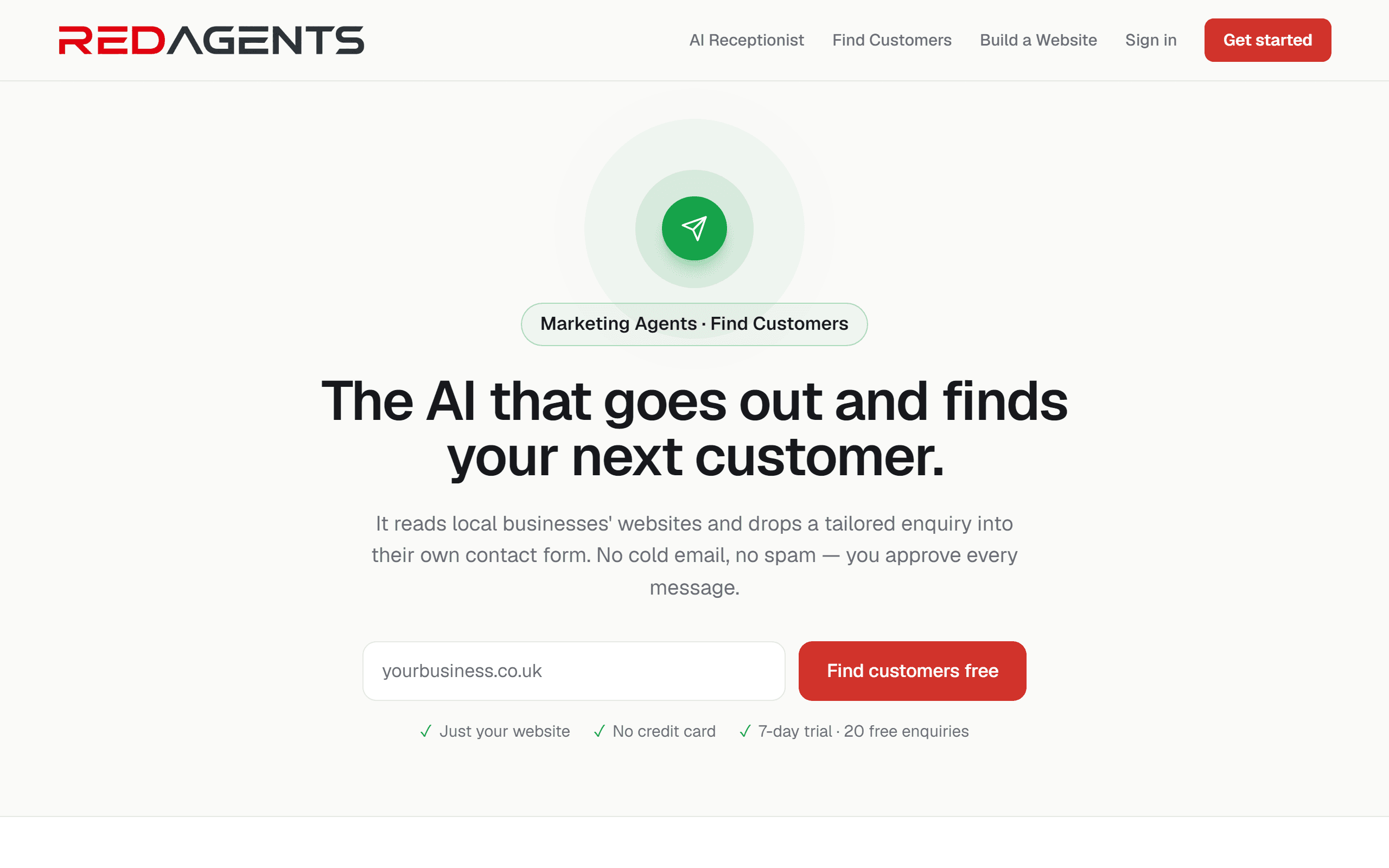
Find Customers is the agent that does that legwork. You give it your website. It works out what you do from that, finds local businesses, reads their site, writes an enquiry tailored to them, and delivers it into their contact form.
Three things worth being precise about, because they're the difference between outreach and spam:
- It uses the contact form they published. Not a bought list, not a scraped email address, not a LinkedIn DM blast.
- Every message is tailored. It reads their site first. The enquiry mentions them specifically — not "Dear Sir/Madam, we offer a range of services".
- You approve every message before it goes. Nothing leaves in your name that you haven't seen. If the tone's wrong or the business isn't a fit, it doesn't go.
That third point matters more than it sounds. It's the thing that stops this becoming a spam cannon. It also means the first week is a bit of work — you're reading and approving — and it gets faster as you learn to trust the pattern.
What happens when someone replies
This is the part people don't plan for, and it's where outreach quietly dies.
A reply doesn't always come back as an email. Quite often the office manager reads your enquiry at 4:50pm, thinks "actually, yes", and rings the number on it. If that call goes to voicemail, you've paid for the enquiry and thrown away the result.
On RedAgents the loop closes: the enquiry goes out, they reply or ring your number, and your AI receptionist answers, books it and tells you. If you've not got anything answering out of hours, that's worth sorting before you turn outreach on — the arithmetic is in what missed calls really cost a UK trades business.
The economics, honestly
Here's the real pricing from the page. Twenty free enquiries to start, no credit card. After that:
| Plan | Price | Enquiries | Cost per enquiry |
|---|---|---|---|
| Free trial | £0 | 20 enquiries | £0 |
| Starter | £29/mo | 10 a day | ~£0.10 (at 30 days) |
| Growth | £69/mo | 25 a day | ~£0.09 |
| Scale | £99/mo | 50 a day | ~£0.07 |
| Pay as you go | £35 once | 100 delivered enquiries | £0.35 |
The per-enquiry figures on the monthly plans assume you actually use your full daily allowance every day, which most people won't at first. Treat them as a floor, not a promise. Pay as you go is the honest number if you want to dip a toe: £35 for 100 delivered enquiries, one payment, credits last until spent.
Do the maths on your own job value
Pick the number that matters: what's one new commercial client worth to you over a year? Say you're an electrician and a letting agent who calls you four times a year at £400 a visit is worth £1,600.
Now the pessimistic version. Take the £35 pay-as-you-go pack: 100 delivered enquiries. Suppose only 5 reply at all, and only 1 of those turns into that letting agent. You've spent £35 to win £1,600 of work.
Now the version where it doesn't work: 100 enquiries, 2 polite "no thanks", nothing else. You've spent £35 and learned your offer or your targeting is off. That's a cheap lesson, but it is a real outcome and you should budget for it happening on your first pack.
Swap in your own numbers. If your average job is £80 and doesn't repeat, the sums get much tighter and you need a far higher hit rate to justify the time you spend approving messages.
Compare that with ads. £35 on Google Ads in a competitive trade might buy you eight or ten clicks. Compare it with a day of your own time doing the same outreach by hand: if you value your hour at £40, twenty enquiries done properly costs you £80 to £130 in time you could have billed.
Where this does not work
Four real limits. If any of these describe you, spend the money elsewhere.
1. Not every business has a contact form
Plenty of small firms publish a phone number and nothing else. Some have a Facebook page and no website at all. Those businesses simply aren't reachable this way. In some sectors — very small trades, market-stall type operations — that's a big chunk of your target list gone.
2. CAPTCHAs block some forms
A proportion of contact forms sit behind a CAPTCHA or similar challenge. Those won't go through. It's not a fault, it's the internet doing what it's designed to do, and it means your reachable universe is smaller than your list of prospects.
3. Replies are not guaranteed
This is a numbers-and-relevance game and nobody can promise you a reply rate. A delivered enquiry means the form was submitted, not that a human read it, not that they cared. Some forms feed inboxes nobody opens. If you need a specific number of leads by Friday, this is the wrong tool — that's what paid ads are for, expensive as they are.
4. Relevance beats volume, every time
Fifty enquiries a day to businesses who have no plausible use for you is worse than ten a day to businesses who do — worse for your reply rate and worse for your reputation locally. If you're a domestic-only tradesperson with no interest in commercial work, or you serve consumers exclusively (most salons, most clinics taking private patients), B2B outreach isn't your channel. Your growth comes from local search, reviews and answering the phone.
Who it actually suits
The pattern that fits best: you sell something another business buys repeatedly or on contract, and one new client is worth several hundred pounds or more.
- Electricians and plumbers chasing letting agents, property managers and small commercial sites
- Cleaners going after offices, gyms and nurseries
- Accountants and bookkeepers looking for a handful of new business clients a year
- Trainers, consultants and IT support who sell to other firms
- Anyone with capacity in the diary and no marketing budget to fill it
How to run it without wasting your first month
- Sort out what happens when they reply first. A number that gets answered, or an AI receptionist doing it. There's a cost breakdown in AI receptionist cost UK.
- Use the 20 free enquiries as a test of your own message, not the tool. Read every one before it goes. If you'd bin it, they will too.
- Be specific about who you want. "Letting agents in Bristol with 20+ properties" beats "local businesses".
- Start on pay as you go if you're unsure. £35 for 100 delivered enquiries is a cheap experiment. Move to a monthly plan when you know your rough hit rate.
- Give it six weeks before you judge it. Business enquiries sit. A facilities manager who reads yours in March might ring in May when their current contractor lets them down.
- Track replies, not sends. The only number that matters is conversations started. If 100 enquiries produce no conversations, change the message or change the targets — don't just buy more enquiries.
The honest summary: contact-form outreach is a slow, cheap, respectable way to keep a trickle of B2B conversations going when you can't afford ads and won't do cold email. It's not a tap you turn for leads on demand. It's more like putting a small amount of effort in every day and finding, a couple of months later, that two of your best clients came from it.
Win new work without the spam folder
RedAgents Find Customers reads each business's website and drops a tailored enquiry into their own contact form — and you approve every message before it goes. From £29/month, 20 free enquiries to try it.
See how Find Customers works →