
Outsourced receptionist vs hiring one: the honest numbers
31 August 2026 · 10 min read

Photo by Christina @ wocintechchat.com M on Unsplash
At some point the phone gets bad enough that you start pricing up a receptionist. Then you see a salary figure, decide it's too much, and go back to missing calls. The salary is the smallest part of the decision — and the comparison is more interesting once you put the real employment costs next to the outsourced ones. Here's the arithmetic, laid out so you can redo it with your own numbers.
Start with the honest disclaimer about salary
Any blog post that tells you a receptionist costs exactly £X a year is guessing. Pay varies enormously by region, by hours, and by what you actually want the person to do. A part-time front-desk role in a market town is not the same money as a full-time receptionist in central London who also handles diaries, invoices and suppliers.
So do this before you trust anyone's numbers, including mine: search current job adverts for "receptionist" plus your town, look at ten of them, and note the range. Check the National Minimum Wage and National Living Wage rates that apply now, because they change each April and they set the floor. Then use your own figure in the sums below.
For the worked examples I'll use a placeholder of £24,000 a year for a full-time hire and £12,000 for a 20-hour-a-week part-timer. They're round numbers chosen so the arithmetic is easy to follow, not a claim about your local market. Swap them out.
What employing someone actually costs
Salary is the headline. The rest is the bill you only meet once you're an employer.
Employer National Insurance
You pay employer NI on earnings above a threshold, on top of the wage. The rate and the threshold are set by government and have moved more than once in recent years, so look up the current employer NI rate and secondary threshold on GOV.UK before you budget. Whatever it is today, it is a real percentage of pay that never appears in the job advert.
Pension contributions
Auto-enrolment means an eligible employee gets a workplace pension and you contribute a minimum percentage of qualifying earnings. Again — check the current minimum employer contribution rather than taking a number from a blog. It's another few percent on top of salary, plus the admin of running the scheme.
Holiday, and who covers it
Statutory holiday in the UK is 5.6 weeks including bank holidays for a full-time employee. That's roughly 28 days. You pay for those days and get no phone cover on them. Either the phone goes back to you and your voicemail, or you pay someone else to sit in the chair.
Sickness, appointments and the school run
Nobody's fault, but it happens. Statutory Sick Pay exists, dentist appointments exist, snow exists. On those days the phone is uncovered unless you've built a plan B. Most small businesses haven't, which is why the owner's mobile ends up as the plan B.
Recruitment and the first few weeks
Advertising a role, reading applications, interviewing, and then two or three weeks where the new person is learning your prices and your regulars. That time costs you either agency fees or your own hours. If it doesn't work out, you pay it again.
The desk itself
A chair, a screen, a phone, a laptop, software licences, maybe a bit more heating and a bit more of the rent per head. Small individually. Not nothing.
Employer's liability insurance and payroll
Employer's liability insurance is legally required once you have staff. Payroll software or an accountant's payroll service is another monthly line. Both are cheap. Both are new.
Do the maths: a part-time hire
Worked example — 20 hours a week
Salary placeholder: £12,000 a year.
Add employer NI and pension at the current rates — call it a low-double-digit percentage of pay once both are in. On £12,000, that's roughly £1,200–£1,800 depending on where thresholds and rates land. Look up today's figures and calculate it properly.
Add recruitment: one-off, but say £300 if you advertise, or an agency fee if you don't.
Add the desk: laptop, phone, software — say £600 in year one, less after.
Add insurance and payroll: say £30 a month, £360 a year.
Rough year one, on those placeholders: somewhere around £14,500–£15,500 for 20 hours a week of cover.
Divide by 52: about £280–£300 a week. Divide by 20 hours: roughly £14–£15 an hour of phone cover — for 20 hours out of the 168 in a week.
That last line is the one worth sitting with. A 20-hour part-timer covers about 12% of the week. Evenings, weekends and their holidays are still yours. If most of your enquiries land at 7pm on a Sunday — and for trades they often do — you've bought cover at the wrong end of the clock. We went through that pattern in more detail in out-of-hours calls: the jobs UK trades never know they missed.
The outsourced side of the ledger
An outsourced receptionist means the answering happens somewhere else — a call centre with human operators, or an AI receptionist. The cost structure is completely different: no NI, no pension, no holiday to cover, no desk, no recruitment. You pay a price and you stop.
What varies wildly is the shape of the price. Traditional services often charge per call or per minute, with out-of-hours costing extra. That means a busy month costs more than a quiet one, and the month you most need help is the month you get the biggest bill. We pulled those models apart in answering service prices: what the UK models really cost.
RedAgents is flat monthly, minutes included, same price at 3am as at 3pm:
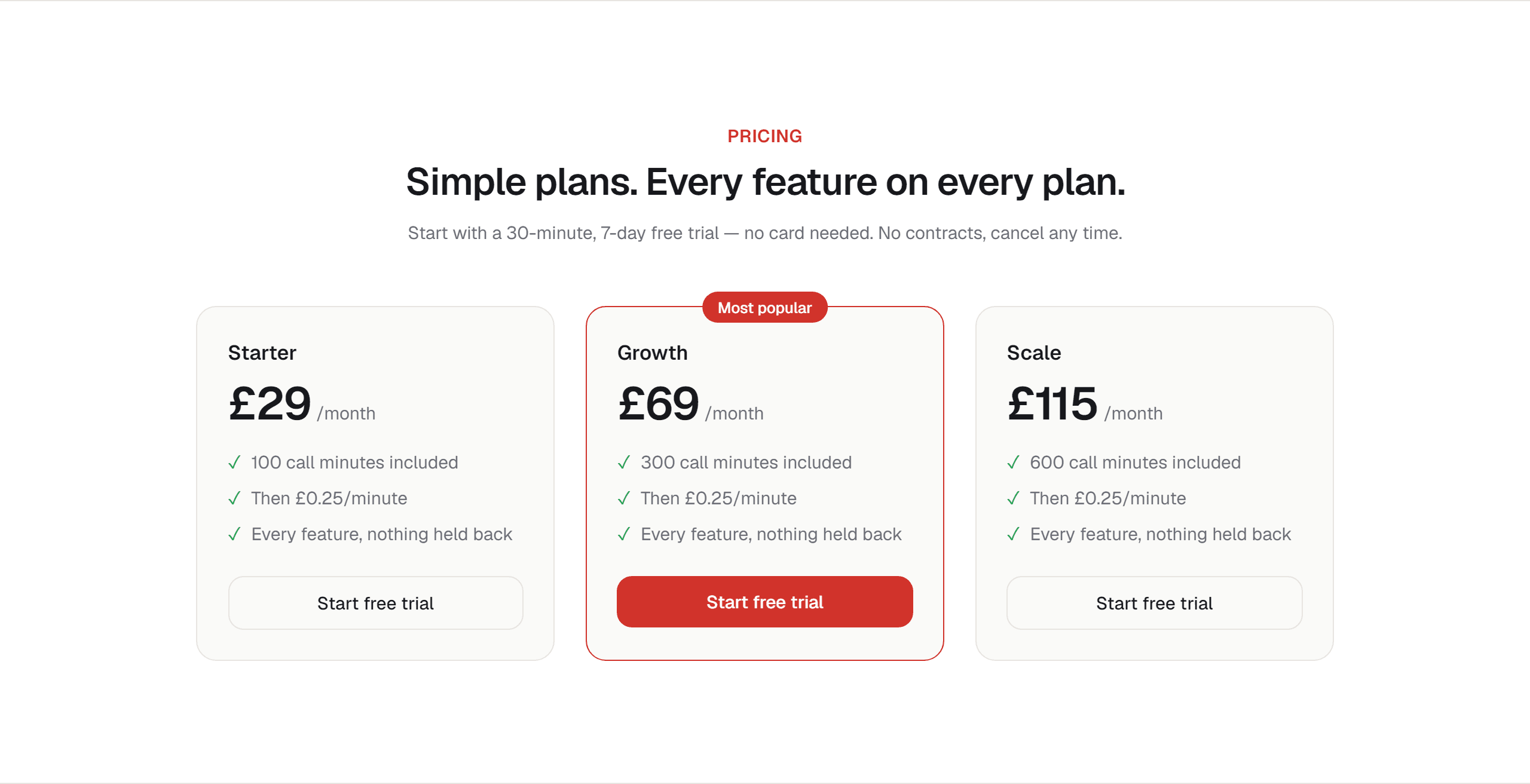
| Plan | Price | Minutes included | Overage |
|---|---|---|---|
| Starter | £29/mo | 100 call minutes | £0.25/minute |
| Growth | £69/mo | 300 call minutes | £0.25/minute |
| Scale | £115/mo | 600 call minutes | £0.25/minute |
Every feature is on every plan. There's a 7-day free trial with 30 call minutes, no card needed, no setup fee and no contract.
Side by side, on the same year
Using the placeholder figures above, and the Growth plan at £69 a month (£828 a year, 300 minutes a month included):
| Part-time hire (20 hrs/wk) | Full-time hire | RedAgents Growth | |
|---|---|---|---|
| Headline pay | £12,000 (placeholder) | £24,000 (placeholder) | — |
| Employer NI | Yes — check current rate | Yes — check current rate | None |
| Pension | Yes — check current minimum | Yes — check current minimum | None |
| Holiday cover | You or a temp | You or a temp | Not applicable |
| Sick cover | You | You | Not applicable |
| Recruitment | One-off, repeats if it fails | One-off, repeats if it fails | None |
| Desk, laptop, software | Yes | Yes | None |
| Hours covered per week | ~20 of 168 | ~40 of 168 | 168 |
| Rough year one total | ~£14,500–£15,500 | ~£28,000–£30,000 | £828 plus any overage |
The gap is large enough that precision doesn't matter much. Even if my salary placeholders are 30% out for your area, the order of magnitude holds: employing someone to answer the phone is a five-figure commitment, and outsourcing the answering is a three-figure one.
Watch the minutes, not the plan name
The one number that can shift the outsourced figure is your call volume. 300 minutes is five hours of talking a month. If your average call runs three minutes, that's 100 calls. Most sole traders and small salons are comfortably inside that. A busy clinic with a lot of long booking conversations might not be.
Check your own volume first
Look at your phone's call log for last month. Count the incoming calls. Multiply by your rough average length in minutes.
If you land at 400 minutes, Growth plus 100 minutes of overage is £69 + £25 = £94, which is still cheaper than Scale would be wasted on you at a quiet time of year — but Scale at £115 gives you 600 minutes and no thinking about it. Pick on your real numbers.
Full breakdown of the overage arithmetic is in AI receptionist cost UK.
Where a hired receptionist wins, and it isn't close
An outsourced receptionist answers a phone. That's the job. There are things a person at your front desk does that no telephone service — human or AI — can do, and pretending otherwise would be daft.
- Greeting someone who walks through the door. If you have a waiting room, a reception desk or a shop floor, someone physically present matters. A voice on a phone line cannot hand a patient a form, offer a coffee, or notice that the person in the corner has been waiting twenty minutes.
- Knowing the team. A good receptionist knows that Dave is off on Fridays, that Sarah will take a difficult client and Mark won't, and that if the boiler parts haven't arrived there's no point booking Tuesday. That knowledge is built over months of sitting in the room.
- Chasing something down the corridor. Walking to the workshop to check whether a job's finished. Catching the technician between appointments. Physically finding a file. All of it is invisible work that keeps a place running.
- Reading a room. Noticing a regular is upset before they say so. Softening bad news in person. Judging when to interrupt you and when not to.
- The other half of the job. Most small-business receptionists don't only answer phones. They chase invoices, order stock, sign for deliveries, sort the post. If you're hiring for that work, the phone comparison is the wrong comparison entirely — you're buying an admin person who also answers calls.
And the plain limit on the outsourced side: an AI receptionist isn't a person. RedAgents is explicit about that — you can change its voice, its manner, what it knows and how it behaves after hours, but you can't change the fact that it isn't human. Some callers will clock it. Some businesses have clients who'd hate it.
The comparison most people should actually make
For a lot of small businesses the real choice isn't "hire someone or outsource". It's "outsource, or carry on missing calls". You were never going to spend £15,000 on a part-timer. The receptionist idea was a fantasy you priced up once and shelved.
In that case the arithmetic is simpler. Take one job you'd win from a call you'd otherwise miss. If a boiler swap is worth £2,000 to you, or a course of six physio sessions is worth £360, or a full head of highlights is worth £110 — how many of those does £828 a year need to save? One boiler. Three colour appointments. Less than three physio courses. Everything after that is profit you weren't getting. There's a fuller version of that sum in what missed calls really cost a UK trades business.
If you're genuinely choosing between the two
A few questions that tend to settle it:
- Do people come to your premises? If yes, and there's a door and a waiting area, you probably need a human at some point in the week. That doesn't stop you covering evenings and weekends with a service.
- When do your enquiries actually arrive? Check the timestamps on your call log. If half are outside 9–5, a daytime hire only fixes half the problem.
- Is the phone the whole job, or a fifth of it? If you need admin done, hire for admin. Then decide separately who answers at 8pm.
- Can you carry the fixed cost in a bad quarter? A salary doesn't shrink when work dries up. A flat £29–£115 a month is easier to sit through, and there's no contract holding you to it.
- What happens on their day off? If the honest answer is "it rings my mobile", you haven't actually solved the missed-call problem — you've bought partial cover and kept the rest.
A hybrid is often the sensible answer: a part-timer for the desk and the walk-ins during your busiest hours, and an outsourced line catching everything they can't — lunch, evenings, weekends, their holiday, the days they're off sick. That's the setup that stops the owner's mobile being the fallback. If you want a closer look at how the overflow actually behaves, what happens when an AI receptionist answers your phone walks through it call by call.
Never miss the call that pays for the month
RedAgents answers every call in your business's name, 24/7, takes the details and texts them to you. 30 minutes free, no card.
Hear it answer →