
Is a 24/7 answering service worth it for a small business?
28 August 2026 · 9 min read
Photo by Vitor Paladini on Unsplash
"24/7" sounds like something every business should want and nobody should pay for. The honest answer is that it's excellent value for some trades and close to pointless for others. This post sorts out which is which, does the arithmetic on a single emergency job, and explains why the pricing model matters more than the cover itself.
First, what 24/7 actually means in practice
Round-the-clock cover isn't one thing. There are three quite different situations it covers, and they don't have the same value:
- Evenings and early mornings. 6pm to 9pm, and 7am to 9am. Plenty of people ring here simply because it's the first quiet moment in their day.
- Weekends. Saturday morning is a real trading window for a lot of trades and salons. Sunday is quieter but rarely dead.
- The true middle of the night. 1am to 5am. For most businesses this is a handful of calls a year. For a locksmith or an emergency plumber, it's the good stuff.
When someone asks "is 24/7 worth it?", they're usually really asking about that third bucket — and worrying they'll pay a premium all year for six calls. That's a fair worry with a traditional service. It's not a worry at all with a flat plan. More on that below.
Who genuinely benefits from round-the-clock cover
The test is simple: does your caller have a problem right now that they cannot postpone? If yes, they will not leave a voicemail. They'll go back to Google and ring the next name down, because the next name might pick up.
Businesses where that's true most of the time:
- Emergency plumbing and heating. Burst pipe, no hot water in February, leak through a ceiling. Nobody sits on that until Monday.
- Locksmiths. Almost the definition of an urgent call. Locked out at 11pm, and the caller will ring five numbers in four minutes.
- Electricians doing fault work. Dead sockets, tripping consumer unit, no power to half the house.
- Vets and out-of-hours animal care. A worried owner at 2am is not going to wait for opening time.
- Emergency glaziers, roofers after a storm, drainage, pest control. Same pattern: the problem is happening to the caller right now.
- Anything with a property manager or letting agent as the customer. They're chasing a tenant complaint and will call round until someone confirms.
There's a second group where 24/7 is less about emergencies and more about when their customers happen to be free. Care agencies, driving instructors, tutors, tradespeople selling to other tradespeople — a lot of those enquiries land after the working day, not because they're urgent but because that's when the caller finally sat down.
Who doesn't need it (and shouldn't pretend otherwise)
Some businesses genuinely get almost all their calls inside office hours, and the honest answer is that overnight cover adds little:
- Appointment-led B2B services. Accountants, solicitors, consultants, commercial cleaners. Your callers are at work when you're at work. A 3am call is usually a wrong number.
- Businesses selling into other office-hours businesses. Your buyer isn't ringing you from the sofa.
- Anyone whose booking already happens online. If 90% of your bookings come through a form or an app, the phone is a minority channel and overnight is a minority of a minority.
- Businesses with a genuine person on reception all day and no evening demand. You've already solved the problem you have.
But — and this matters — "I don't need 3am" is not the same as "I don't need cover outside 9 to 5". A salon that closes at 6pm still loses bookings at 6:40pm. A physio clinic with a front desk still misses the lunchtime hour. We've written about both in more detail in the salon post and the clinic post. The valuable window for appointment-led businesses is usually the shoulders — early morning, lunch, and the two hours after closing — plus Saturday. Not the small hours.
The thing that actually decides the answer: how you're charged
Here's where most of the "is it worth it" debate comes from. With a traditional human answering service, 24/7 usually costs extra. Out-of-hours attracts a premium, because someone has to be awake. So you end up doing a cost-benefit calculation on overnight cover specifically — and for a business with six night calls a year, the sums look bad.
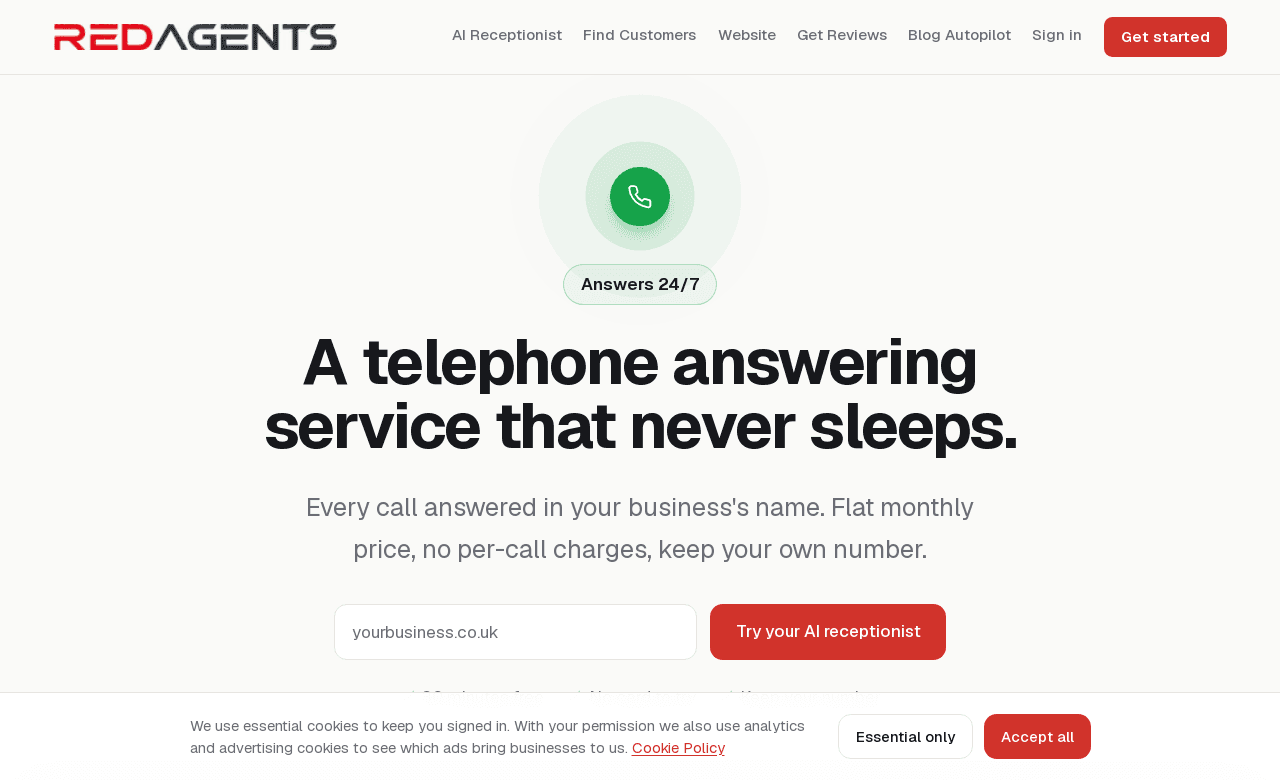
A flat monthly plan removes the calculation. On the RedAgents answering service, the page is explicit about it: flat monthly price, minutes included, 24/7 and weekends at the same price, and no per-call charges. A busy month costs the same as a quiet one. Which means overnight cover isn't a decision you make — it's just on.
| Traditional answering service | RedAgents | |
|---|---|---|
| Charging | Charged per call or per minute | Flat monthly price, minutes included |
| Out of hours | Costs extra | 24/7 and weekends, same price |
| Busy periods | A queue at busy times | Never a queue — answered at once |
| How you find out | Messages by email, later | Texted to you within seconds |
That table is straight from the product page, and it's the honest crux of the argument. The question isn't really "is 24/7 worth a premium?" It's "if 24/7 carries no premium, is there any reason to switch it off?" Usually not — apart from your own preference for a quiet night, which is a real and legitimate reason. You can set what happens after hours: take a message, or treat emergencies differently. So you can have the call answered without having your phone go off at 4am.
The arithmetic on one emergency job
Let's be specific, with assumptions you can swap for your own numbers.
Do the maths: one 11pm leak
Say you're a plumber. An emergency call-out plus a repair is worth £350 to you, and you keep, say, £220 of that after materials and your time. Emergency work usually pays better than planned work, which is the whole point.
The Growth plan is £69/mo with 300 minutes included — call it £828 a year.
So the service pays for a year of itself with four of those jobs. £220 × 4 = £880. That's roughly one every three months.
Now widen it. If your trade also lands the occasional bigger job out of hours — a boiler swap at £2,000 with, say, £700 of margin to you — a single one of those covers the plan for nearly a year on its own.
Run it the other way if you prefer: on the Starter plan at £29/mo (£348 a year), one £350 call-out you'd otherwise have missed puts you in profit for the year.
That's the case for emergency trades in one box. It isn't a clever argument — it's just that emergency jobs are high-value and the plan is cheap, so the break-even is very low.
Now run the same sums for an accountant. Suppose you get two genuinely out-of-hours calls a month and one in twelve becomes a client worth £900 a year. That's still worth more than £828 — but the margin is thinner and it takes longer to show up. The maths works, but it's a business decision rather than a no-brainer. And note that in that scenario, the value came from the evening calls, not the night ones.
How to work out your own answer in a week
You don't have to guess. You already have the data on your phone.
- Open your call log and scroll back a month.
- Mark every call you didn't answer. Include the ones you rang back — a call you returned three hours later is still a call the customer might have solved elsewhere.
- Note the time on each. Group them: inside hours, evening, weekend, overnight.
- Multiply the count in each group by your average job margin. Then be honest about your conversion rate — not every missed call was a buyer.
- Compare the total against £29, £69 or £115 a month.
Most owners who do this find the overnight column is small and the evening-plus-weekend column is bigger than they expected. Which is the real reason 24/7 is worth having: not the 3am hero call, but the fact that it makes the 7pm and Saturday-morning calls somebody's job. There's a longer version of this exercise in what missed calls really cost a UK trades business.
Where a 24/7 AI answering service is the wrong fit
Being straight about this, because the pricing model doesn't fix everything.
- You need a person, not an assistant. The product page says it plainly: the one thing you can't change is that it isn't a person. If your callers are distressed, vulnerable, or need genuine judgement on the call, a human service is the right buy — and you should expect to pay the out-of-hours premium for it.
- Overnight calls need dispatch, not a message. If the value only exists when someone is physically driving out at 2am, answering the phone is step one of a job you still have to staff. The receptionist takes the details and texts you within seconds; it can't send a van.
- Your callers are genuinely all 9-to-5. If you did the call-log exercise and found nothing outside hours, you may still want cover for busy periods and lunch — but don't buy it for the 24/7 badge.
- You won't act on the messages. A perfectly logged 10pm enquiry that you read on Thursday isn't worth much. The workflow only pays if someone follows up in the morning.
- Regulated or clinical triage. If a call needs a qualified clinician to decide what happens next, that has to stay with a qualified clinician.
The middle option nobody mentions
You don't have to choose between "always on" and "nothing". Because forwarding only sends the calls you miss, your own phone still rings first and you still answer when you can. Nothing changes for calls you pick up. What changes is what happens to the rest — instead of voicemail, they get answered, the job details get taken properly, and you get a text the moment the call ends with a full transcript and recording.
And you control the after-hours behaviour separately. Message-only overnight, full booking during the day, emergencies handled differently — those are settings. So a business that doesn't want 3am work can still have 3am calls captured politely instead of dumped into a voicemail nobody listens to.
If you want to compare the options properly rather than just the AI one, the honest comparison of AI receptionist vs answering service vs voicemail lays out all four routes, and answering service prices explains how per-call, per-minute and flat models behave differently once volume moves. The pricing model is the part most people get caught by — and with 24/7, it's the part that decides whether the answer is yes.
Never miss the call that pays for the month
RedAgents answers every call in your business's name, 24/7, takes the details and texts them to you. 30 minutes free, no card.
Hear it answer →